Causes

How a Hernia Develops

Choose a preferred language

A hernia bulge may appear suddenly, but hernias often take months or years to develop. They grow larger as pressure inside the body presses the intestines or other tissues out through a weak area in the belly (abdominal) wall. This is often at the belly button or a site of a past surgery. With time, these tissues can bulge out beneath the skin.


Stages of hernia development

The wall weakens or tears: The abdominal lining bulges out through a weak area and begins to form a hernia sac. The sac may contain fat, intestine, or other tissues. At this point, the hernia may not cause a visible bulge.
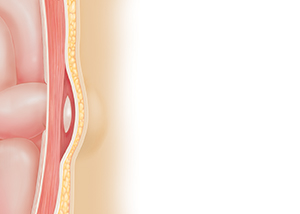
Cross section of body wall showing hernia. Intestine slightly protruding through defect in muscle underneath skin.

The intestine pushes into the sac: As the intestine pushes farther into the sac, it forms a visible bulge. The bulge may flatten when you lie down or push against it. This is called a reducible hernia. It does not cause any immediate danger.
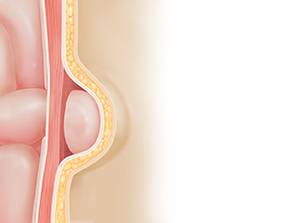
Cross section of body wall showing hernia. Intestine protruding through defect in muscle underneath skin.

The intestine may become trapped: The sac containing the intestine may become trapped by muscle (incarcerated). If this happens, you won’t be able to flatten the bulge. You may also have pain. You may need prompt treatment.
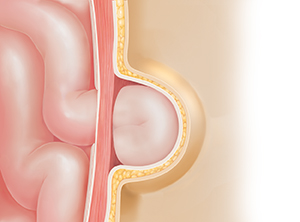
Cross section of body wall showing hernia. Intestine protruding through defect in muscle underneath skin.

The intestine may become strangulated: If the intestine is tightly trapped, it becomes strangulated. The strangulated area loses blood supply and may die. This can cause severe pain and block the intestine. You need emergency surgery.
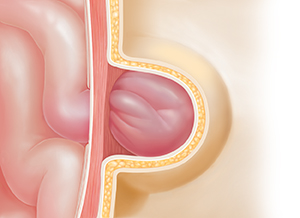
Cross section of body wall showing hernia. Intestine protruding through and trapped in defect in muscle underneath skin.

Date Last Reviewed: 04/01/2024

© 2000-2025 The StayWell Company, LLC. All rights reserved. This information is not intended as a substitute for professional medical care. Always follow your healthcare professional's instructions.



Your family’s health is our priority.

From routine checkups to specialized pediatric care, our family of doctors is here for yours.

Find a Doctor
Related Articles
Read article
Digestive Health
What Is a Hernia?

A hernia is when an organ or tissue pushes through a weak area in the belly (abdominal) wall. Read on to learn about types of hernias and how they are diagnosed and treated.

Read article
Digestive Health
Hernias in Children

A hernia occurs when a section of bowel pushes out through a weakness in the muscle. The hernia looks like a bulge under the skin. In baby boys, a bulge in the scrotum is the most common type of hernia and is the result of a persistent canal between the scrotum and abdomen that normally closes when a fetus is developing. A hernia can move back into the abdomen through the passage. So you may not see the bulge all the time. You may see it most when your baby is straining (such as during crying, feeding, or a bowel movement).

Read article
Surgery
Discharge Instructions for Open Hernia Repair

You had a procedure called open hernia repair. A hernia is a tear or weakness in the wall of the belly. It causes internal organs to protrude through the wall of muscle or tissue that normally holds it in place. Surgery can help fix the weakness and stop symptoms.

Read article
Surgery
After Laparoscopic Hernia Repair

A hernia is a defect in the tough tissue covering the musculature of the abdominal wall (fascia). During laparoscopic hernia surgery, a surgeon inserts a telescope attached to a camera as well as surgical instruments through tiny incisions in your abdomen. The surgeon repairs the hernia with a mesh, which patches the tear or weakness in the fascia.