Definition

Understanding Circulation

Choose a preferred language

Blood flows from the heart to the body and back to the heart. This nonstop flow is called circulation. Blood flows through blood vessels. These are hollow muscular tubes. There are 3 main types of blood vessels:

  • Arteries carry oxygen-rich blood away from the heart.

  • Veins return oxygen-poor blood to the heart.

  • Capillaries are tiny blood vessels that connect arteries and veins. Capillaries have thin walls that let oxygen and nutrients pass through them to your body parts. They also allow waste products to move from your body parts to the blood.
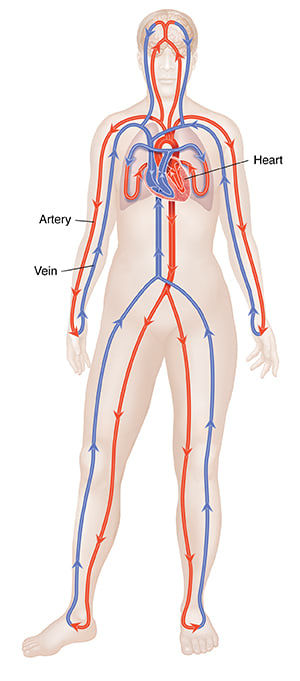
Front view of female body showing arteries, veins, heart, and lungs with closed circulation system.

Online Medical Reviewer: Anne Fetterman RN BSN

Online Medical Reviewer: Deepak Sudheendra MD

Online Medical Reviewer: Raymond Kent Turley BSN MSN RN

Date Last Reviewed: 04/01/2024

© 2000-2025 The StayWell Company, LLC. All rights reserved. This information is not intended as a substitute for professional medical care. Always follow your healthcare professional's instructions.


Related Articles
Read article
Heart Health
Overview of the Vascular System

Detailed information on vascular conditions, including a description of the vascular system, causes and effects of vascular disease, and a full-color anatomical illustration.

Read article
Heart Health
About the Heart and Blood Vessels

Detailed anatomical description of the heart's blood vessels, including simple definitions and a labeled, full-color illustration.

Read article
Heart Health
How the Heart Works

Learn how the heart works.

Read article
Heart Health
How Your Heart Works - Animation

Your heart is a pump that is responsible for delivering blood to all parts of your body. Arteries carry oxygen-rich blood from the lungs to nourish the cells, and veins transport oxygen-poor blood on its way back to the heart and lungs. This animation shows how the heart and circulatory system work.