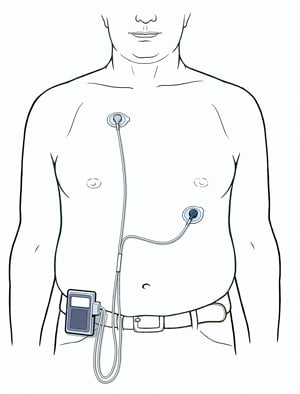
Event monitoring is a painless way to record your heart's electrical activity. The monitor is a small, battery-operated, portable electrocardiogram (ECG) machine. The monitor may have a wire or wires, or it may be a patch without wires. You can get your monitor at a hospital, at a test center, at a doctor's office, or in the mail.
The event monitor lets you record your heart rate and rhythm when you feel symptoms. Some event monitors can find and record abnormal heart rhythms in real time, with or without symptoms. Some event monitoring records your heart rhythm for your doctor to review at a later time. Some wireless monitors allow data to be sent to your doctor's office for evaluation right after an event is recorded. You may carry this monitor for a few days or weeks.
Cautions when using an event monitor
Stay away from electric blankets, microwave ovens, electric toothbrushes or razors, magnets, metal detectors, and high-voltage areas, such as power lines. They may affect the recording.
Your event monitor
Your doctor will show you how to use your event monitor. Wear it as instructed all the time. Some event monitors use wires to record the heart rhythm. Newer event monitors use patches placed over the heart to record the heart rhythm. When you feel a symptom, push the button to start recording. (Some monitors start and stop recording automatically when an abnormal rhythm is detected.) Your doctor will tell you how to do this.
Event monitor diary
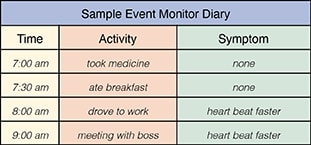
Keep a diary of things you do during the day. This is important. It could help you match your symptoms to times when your heart is beating abnormally. Your diary may be a paper form, an online website, or a phone app. Your doctor's office will tell you which one to use.
- Note the day and time for each entry you make.
- Note all activities. This includes when you take medicines, drive, take a nap, walk, sit down, exercise, or feel stress.
- Note any symptoms you feel. These might be fluttering heartbeats or skipped beats, chest pain, back pain, nausea, or other symptoms. Also write down what was going on around you when the symptoms occurred. Write down any symptoms, even if you are not sure they are important.
Online Medical Reviewer: Ronald Karlin MD
Online Medical Reviewer: Stacey Wojcik MBA BSN RN
Online Medical Reviewer: Steven Kang MD
Date Last Reviewed: 06/01/2026
© 2000-2026 The StayWell Company, LLC. All rights reserved. This information is not intended as a substitute for professional medical care. Always follow your healthcare professional's instructions.