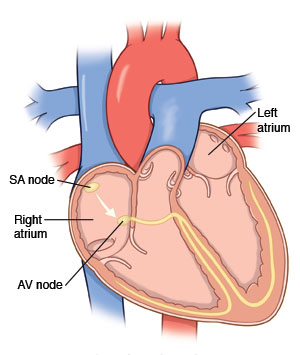
You had a cardioversion today. A cardioversion is done to correct a fast or irregular heartbeat. It is an electrical shock applied to the chest. The shock reset your heart rhythm back to normal. Your chest wall and chest muscles may feel sore for a few days. Some redness may appear on the skin on your chest where the cardioversion patches were applied. That will go away within a week.
To get ready for this procedure, you were given medicine to help you relax and to reduce pain. Depending on the medicine used, it could take from a few minutes to several hours for the effect to wear off. You won't be allowed to go home until you have returned to your normal mental and physical status.
Home care
Follow these guidelines when caring for yourself at home:
-
Have a responsible adult watch you for the first few hours. This is in case your condition gets worse.
-
Don’t take any oral medicine for pain or sleep during the next 4 hours. These medicines might react with the medicines you were given in the hospital. This can cause a much stronger response than usual.
-
Don’t drink any alcohol for the next 24 hours.
-
Don’t drive or operate dangerous machinery during the next 24 hours.
-
Your health care provider may prescribe medicines to stop the abnormal heart rhythm from coming back. Take these medicines as directed. For some arrhythmias, you may need to take blood thinners afterward either in the short or long term. This course of blood thinners should not be interrupted. Don't schedule other invasive procedures during this time. Interrupting this medicine could increase your risk for a stroke after a cardioversion.
-
You may use acetaminophen to control pain, unless another pain medicine was prescribed. Ibuprofen may also be an option. But it can increase the risk of bleeding when it's taken with blood thinners. If you have chronic liver or kidney disease, talk with your provider before taking these pain medicines. Also talk with your provider if you’ve ever had a stomach ulcer or gastrointestinal bleeding.
Follow-up care
Follow up with your health care provider as scheduled.
Call 911
Call
-
Have pain in your chest, arm, shoulder, neck, or upper back.
-
Have trouble breathing.
-
Have problems speaking or seeing.
-
Have weakness in an arm or leg.
-
Can't move your arm or leg on one side of your body.
-
Have uncontrolled bleeding from blood-thinning medicines.
-
Lose consciousness (pass out).
When to get medical advice
Call your health care provider right away if you:
-
Feel weak, dizzy, or lightheaded.
-
Feel short of breath.
-
Feel like your heart is fluttering or beating fast, hard, or irregularly (palpitations).
-
Have more than minor skin discomfort or redness where the cardioversion pads were placed.
Online Medical Reviewer: Rajadurai Samnishanth Researcher
Online Medical Reviewer: Robyn Zercher FNP
Online Medical Reviewer: Stacey Wojcik MBA BSN RN
Date Last Reviewed: 03/01/2025
© 2000-2026 The StayWell Company, LLC. All rights reserved. This information is not intended as a substitute for professional medical care. Always follow your healthcare professional's instructions.