Overview
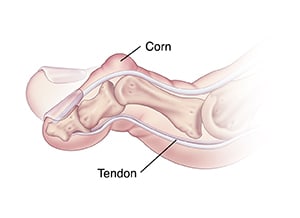
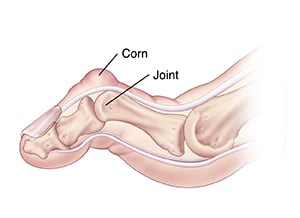
With hammertoes, one or more toes curl or bend abnormally. This can be caused by an inherited muscle problem, an abnormal bone length, or poor foot mechanics. The affected joints can rub inside shoes, causing corns (buildups of dead skin).
There are many nonsurgical treatments for hammertoes. If these don't work, you may want to consider surgery.
Flexible hammertoes
When hammertoes are flexible, you can straighten the buckled joints. Flexible hammertoes may become rigid over time.
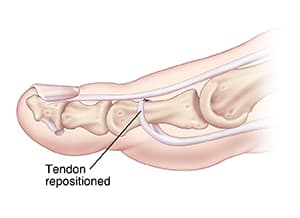
Tendon release
This treatment helps release the buckled joint. The bottom (flexor) tendon may be repositioned to the top of the affected toe (flexor tendon transfer). Sometimes, the top or bottom tendon is released but not repositioned (tenotomy).
Rigid hammertoes
Rigid hammertoes are fixed (not flexible). You can't straighten the buckled joints. Corns, pain, and loss of function may be more severe with rigid hammertoes than with flexible ones.
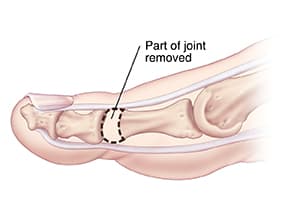
Arthroplasty
A part of the joint is removed, and the toe is straightened. In some cases, the entire joint may be replaced with an implant. When healed, the bones become connected with scar tissue, making your toe flexible.
Fusion
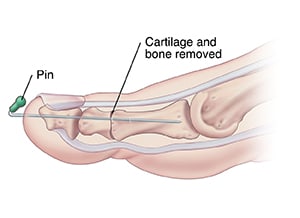
First, the cartilage and some bone on both sides of the joint are removed. Then, the toe is straightened, and the two bones are held together, often with a pin. The pin is removed after several weeks. Once your foot heals, the toe will be less flexible, but more stable.
Healing after surgery
The severity of your condition, number of toes involved, and type of surgery done will affect your recovery time. Many people are able to walk right after surgery with a special surgical shoe. Full healing can take several weeks. Your doctor can advise you on what to expect after surgery.
Featured in
Online Medical Reviewer: Rahul Banerjee MD
Online Medical Reviewer: Raymond Turley Jr PA-C
Online Medical Reviewer: Rita Sather RN
Date Last Reviewed: 04/01/2024
© 2000-2026 The StayWell Company, LLC. All rights reserved. This information is not intended as a substitute for professional medical care. Always follow your healthcare professional's instructions.