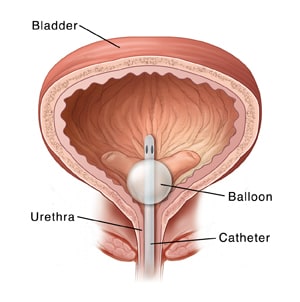
A Foley catheter, also called an indwelling urinary catheter, is a flexible plastic or rubber tube that is placed through the urethra and into the bladder. The urethra is the opening where urine comes out. The catheter helps drain urine from the bladder. There is a small balloon on the end of the tube that is inflated after the catheter is put in place. This keeps the catheter from sliding out of the bladder.
A Foley catheter is used when you are unable to pass urine (urinary retention). It's also used when there is loss of bladder control (incontinence). It's also used after bladder or prostate surgery.
Home care
- Take all the prescribed medicines including antibiotics as advised by your doctor. Do not stop taking the medicines even if you feel better before you finish the medicine.
- Wash your hands well with soap and water before and after handling a Foley catheter and collection bag.
- It's important to keep bacteria from getting into the collection bag. Don't disconnect the catheter from the collection bag.
- Use a leg band to secure the drainage tube, so it doesn't pull on the catheter.
- Don't try to pull or remove your catheter. This will injure your urethra. It must be removed by your your doctor or a nurse.
- Drain the collection bag when it becomes full using the drain spout at the bottom of the bag.
- For a penis that is not circumcised, make sure the foreskin is gently returned to its normal position. Do this after the catheter is placed and after catheter care and cleaning. This helps prevent the foreskin from becoming tight around the tip of the penis, which can lead to swelling or tissue damage.
Follow-up care
Follow up with your doctor as advised. This is for repeat urine testing and for catheter removal or replacement.
When to get medical advice
Call
Contact your doctor right away if:
- You have a fever of 100.4ºF (38ºC) or higher, or as directed by your doctor.
- You have bladder pain or fullness.
- You have swelling in your belly, nausea or vomiting, or back pain.
- There is blood or urine leakage around the catheter.
- Bloody urine is coming from the catheter (if this is a new symptom).
- The catheter falls out.
- The catheter stops draining for 6 hours.
- You are feeling weak.
Author: Ignite Staff
Online Medical Reviewer: Heather M Trevino BSN RNC
Online Medical Reviewer: Melinda Murray Ratini DO
Online Medical Reviewer: Shaziya Allarakha MD
Date Last Reviewed: 01/01/2025
© 2000-2026 The StayWell Company, LLC. All rights reserved. This information is not intended as a substitute for professional medical care. Always follow your healthcare professional's instructions.