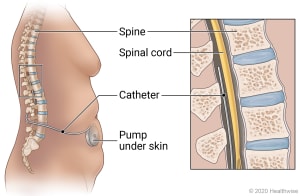
Your intrathecal pain pump implant is a way to treat your chronic pain. It pumps pain medicine through a thin, flexible tube (catheter) into the space around your spinal cord. The implant needs some special care to work safely to control your pain.
After your pump is implanted
Be gentle with the pump area. Don’t pull clothing tightly over it. Don’t move too quickly, exercise, or play sports in ways that may jerk the pump around.
Follow all instructions from your healthcare team. These may include:
-
Keeping your incision site clean and dry
-
Not raising your arms over your head
-
Not bending or twisting at the waist for 6 weeks
-
Not lifting more than 5 pounds
-
Stopping certain medicines
Watching for problems
Check your pump site every day. Call your healthcare provider if any of these happen:
-
A new lump or bulge under the skin near the pump
-
You see signs of infection around the incision. These include more redness, pain, or swelling.
-
The pump has moved
-
The pump is beeping or making other sounds
What may affect your pump
The metal in your implant may set off an alarm at a security checkpoint at a store or airport. Ask your healthcare team for a wallet card that tells people you have an implant.
Your implant device may be affected by strong magnetic fields. Don’t go in an MRI machine without telling the radiologist about your implant. Don’t go near any equipment that has a strong magnetic field. This includes some industrial machines and welding tools.
Tell all healthcare providers that you have the implant. Some types of medical treatment can cause problems with the pump. These include:
-
Radiation therapy
-
Ultrasound
-
Hyperbaric therapy
-
Short-wave diathermy
-
Bone-growth stimulation
Medicine refills and battery changes
Your healthcare team will tell you how often:
-
The pump needs to be refilled. This may be done every 1 to 6 months. The device will beep if the level of medicine gets too low. The pump is refilled with a needle through the skin.
-
The battery needs to be changed. If the device has a battery, this will need to be replaced every 3 to 7 years. This is done in surgery while you are under anesthesia.
When to call your healthcare provider
Call your healthcare provider right away if any of these happen:
-
Side effects from the medicine, such as nausea or trouble peeing
-
Chills or fever of 100.4°F (38.0°C) or higher, or as advised by your provider
-
Signs of infection around the incision. These include pus or odor coming from the incision, or more redness, pain, or swelling.
-
Pain that doesn’t get better, or comes back
-
Headaches that don’t go away, or that come back after the first week
-
Severe headaches
-
Dizziness
-
Sudden sleepiness
-
New pain or numbness
Call 911
Call
-
Loss of bladder or bowel control
-
Trouble breathing
Date Last Reviewed: 04/01/2022
© 2000-2026 The StayWell Company, LLC. All rights reserved. This information is not intended as a substitute for professional medical care. Always follow your healthcare professional's instructions.