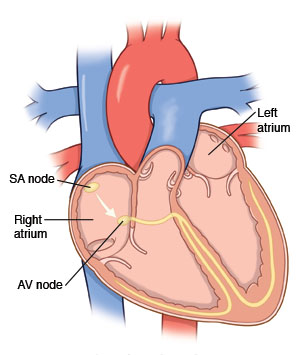
You had cardioversion today. In this procedure, a medicine was put into one of your veins. Or it was given to you to take by mouth (orally). This caused your heart to go back to a normal rhythm. In most cases, you should feel back to normal by the time you go home.
Home care
Follow these guidelines when caring for yourself at home:
-
You can go back to your usual activities once you feel back to normal.
-
Your health care provider may prescribe medicines to stop the abnormal heart rhythm from coming back. Take these medicines as directed. If you have certain rhythm problems, such as atrial fibrillation or atrial flutter, you may need to take blood thinners for at least 4 weeks after a cardioversion. If possible, don't schedule any surgeries or dental procedures during this time. This is so you won't have to stop taking the blood thinners. Stopping the medicines can raise your risk for stroke.
Follow-up care
Follow up with your health care provider, or as advised. You may need more testing. This might be an echocardiogram or event (holter) monitor. An event monitor checks your heart rhythm. Not all people with irregular heart rhythms have symptoms.
Call 911
Call
-
Pain in your chest, arm, shoulder, neck, or upper back
-
Trouble breathing
-
You have problems speaking or seeing
-
Weakness in an arm or leg
-
You can move your arm or leg on one side of your body
-
Fainting
When to call your doctor
Contact your doctor right away if:
-
You have weakness, dizziness, or lightheadedness.
-
You feel like your heart is fluttering or beating fast, hard, or irregularly (palpitations).
Online Medical Reviewer: Marianne Fraser MSN RN
Online Medical Reviewer: Rajadurai Samnishanth Researcher
Online Medical Reviewer: Robyn Zercher FNP
Date Last Reviewed: 02/01/2025
© 2000-2025 The StayWell Company, LLC. All rights reserved. This information is not intended as a substitute for professional medical care. Always follow your healthcare professional's instructions.